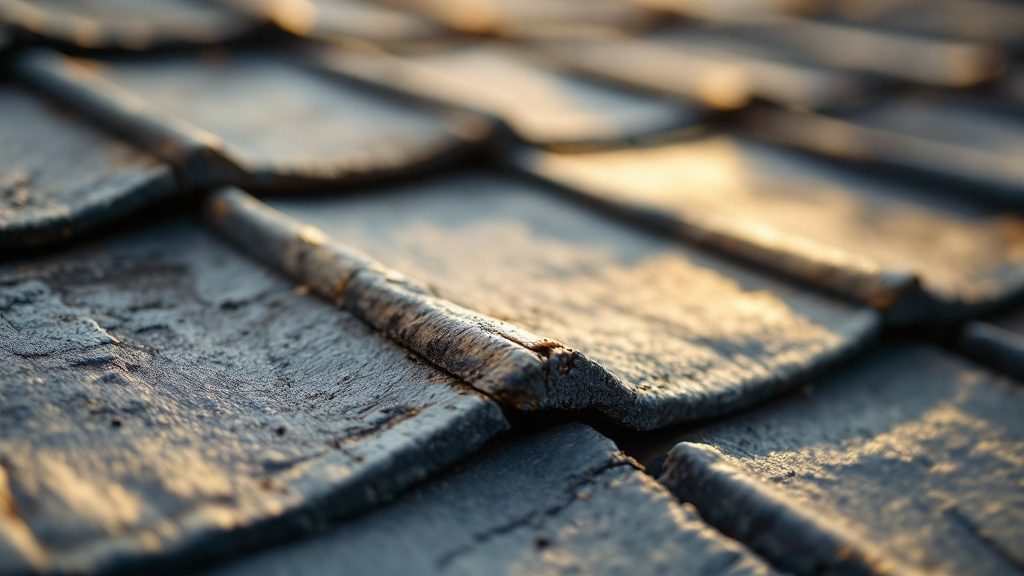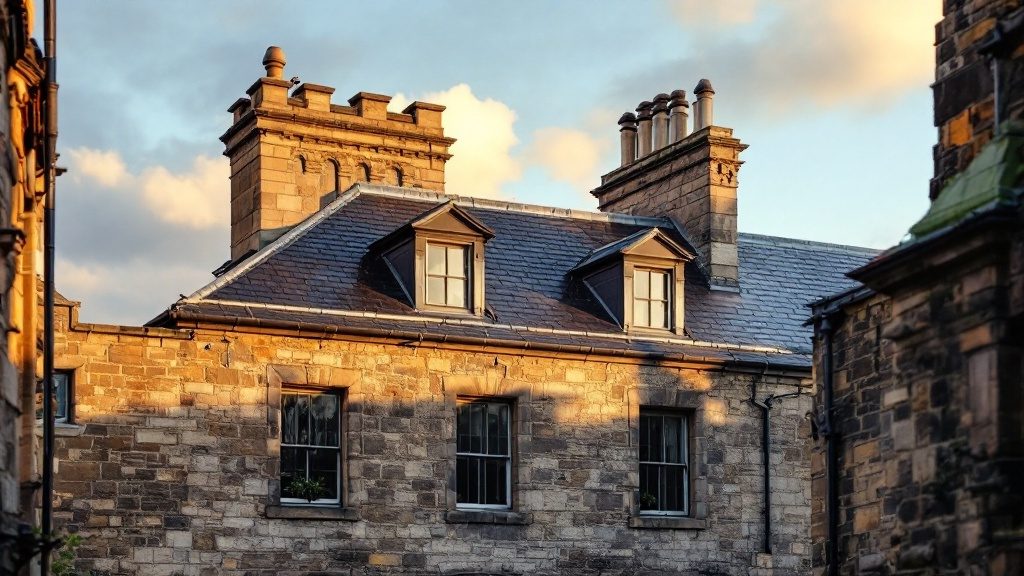
More than half of Edinburgh's historic core is protected. If you own a flat in the New Town, a townhouse in Stockbridge or a tenement in the Old Town, there's a strong chance your building is listed — and that changes how the roof above you can be repaired. This guide walks you through consent, conservation practice, choosing the right specialist, materials and realistic timelines, so a heritage repair goes smoothly the first time.
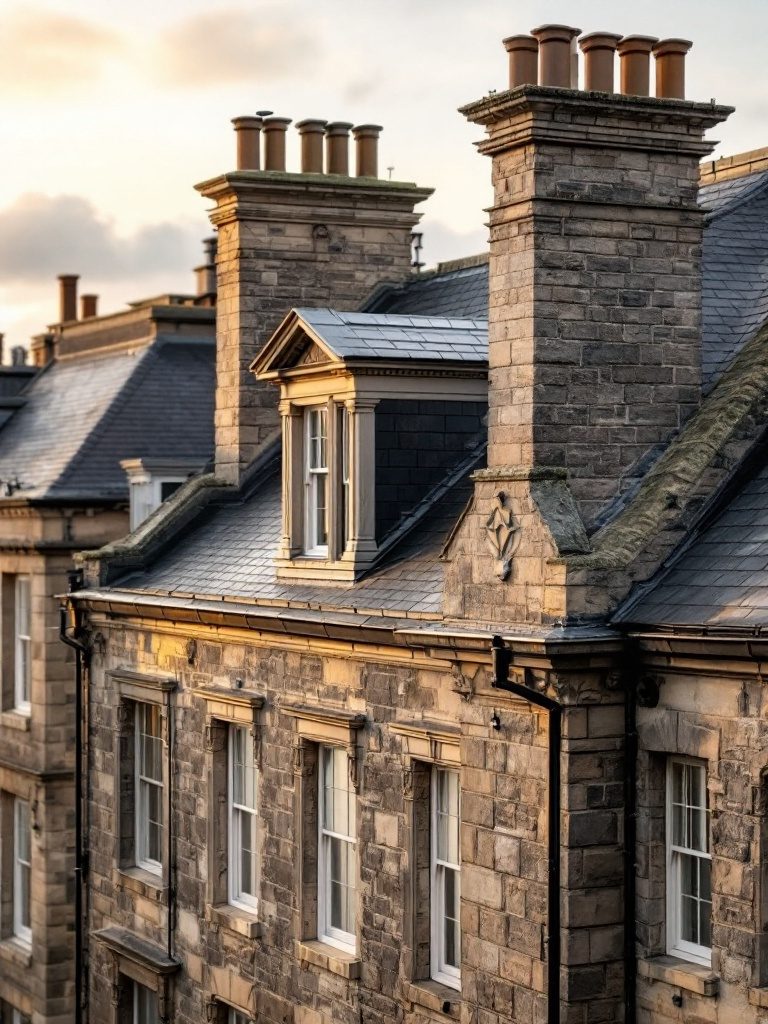
First: is your roof actually protected?
Listing in Scotland is graded A, B or C, and it applies to the whole building — roof, chimneys, rainwater goods and all. Much of Edinburgh's centre also sits inside a Conservation Area and the UNESCO World Heritage Site, which brings its own controls even on unlisted stock. You can check your address in seconds on the Historic Environment Scotland (HES) portal, or ask us — we look it up as part of every heritage survey.
The practical upshot is simple: on a protected building you can't just swap slate for whatever's cheapest on the merchant's shelf. The character of the roof is part of what's protected, and the repair has to respect it.
The golden rule: a genuine like-for-like repair — same slate, same detailing, same method — usually counts as maintenance and needs no formal consent. The moment you change the material, profile or appearance, you're likely into Listed Building Consent territory. When in doubt, ask before you start.
Do you need Listed Building Consent?
This is the question that stops most homeowners in their tracks. The honest answer depends entirely on what you're doing. Here's the rough split we use on the ground — but your local planning authority always has the final word.
Like-for-like maintenance
- Replacing a few slipped slates with matching slate
- Renewing a tired lead flashing or valley in lead
- Repointing a chimney in matching lime mortar
- Clearing and repairing cast-iron rainwater goods
Change of material or look
- Swapping natural slate for concrete or synthetic tiles
- Adding rooflights, dormers or solar panels
- Altering a chimney, ridge line or roof profile
- Replacing lead with modern coated substitutes
Carrying out unauthorised work to a listed building is a criminal offence in Scotland, and the council can require you to put it back at your own cost. It's a rule worth taking seriously — but it isn't there to trap you. In practice, a good conservation roofer keeps you the right side of it without any drama.
What Historic Environment Scotland practice really means
HES guidance for traditional roofs boils down to a handful of sensible principles, and every job we take on a protected building follows them:
- Repair, don't replace. Sound original slate is salvaged and re-laid; only genuinely failed slates are renewed. Minimal intervention protects both fabric and value.
- Match the material. Scotch or Welsh slate is matched by size, thickness and colour — reclaimed where a close new match isn't available.
- Use traditional detailing. Lead flashings and valleys, lime mortar bedding, copper or lead nails — not mastic and modern shortcuts that fail early and look wrong.
- Keep it reversible. Repairs should be able to be undone in future without damaging the historic fabric underneath.
- Record what you do. Before-and-after drone footage and a simple written record — useful for you, and often expected by the conservation officer.
The Castlerock way: we survey by drone first, so you and the conservation officer can both see exactly what's up there before anyone commits — no scaffolding, no guesswork. The half-price drone survey — just £60 (usually £120) is fully refundable against your works, listed building or not.
Choosing the right specialist
Heritage roofing is not a job for a general builder with a scaffold and a pallet of concrete tiles. The wrong repair can knock value off a protected property and land you with an enforcement notice. Before you hire, make sure your roofer can honestly tick these off:
- Proven listed-building experience — ask to see photos of comparable Edinburgh conservation jobs, not just modern re-roofs.
- Works to HES conservation practice and is comfortable liaising with the council's conservation officer on your behalf.
- Fully insured for work on protected structures, with a written workmanship guarantee — ours is 10 years.
- Fixed, itemised quotes in writing — never a vague day rate that balloons once the scaffold's up.
- Sources traditional materials — real slate, lead and lime, with reclaimed stock on hand for matching.
How a conservation repair actually runs
Homeowners are often surprised how orderly a heritage repair can be. Here's the typical path for a listed roof in Edinburgh, from first call to final sign-off.
-
Day one
Half-price drone survey (£60)
We photograph every slope, chimney and valley from the air and confirm the listing grade — no scaffolding, just £60, fully refundable, no obligation.
-
Within a few days
Fixed, itemised quote
You get the footage plus a clear written price and a note on whether Listed Building Consent is likely to be needed.
-
If required
Consent & conservation officer
For anything beyond like-for-like we help prepare the application and liaise with the council — typically an eight-week determination.
-
Works week
Traditional repair on site
Sound slate salvaged and re-laid, failed slate matched, lead and lime detailing renewed to HES practice — tidy team, PPE, respect for the building.
-
On completion
Sign-off & guarantee
Final drone pass, a written record of what was done, and your 10-year workmanship guarantee. One repair, lasting peace of mind.
What heritage work typically costs
Conservation repairs cost a little more than a like-for-like patch on a modern roof — real slate, lead and lime aren't cheap — but our prices are fixed and quoted in writing before we start. No day-rate surprises.
A listed roof isn't a problem to be solved once. It's two hundred years of someone's craft, handed to you for a while — the job is to pass it on in better shape than you found it.
Whether it's a single slipped slate on a Georgian terrace or a full conservation re-slate on a category A-listed townhouse, the principles never change: repair before replace, match the materials, follow HES practice, and keep the paperwork straight. Get those right and a protected roof will out-live all of us. See our full approach to listed-building conservation, or book a survey and we'll take a proper look.